
Cyberpunk 2077 - Braindance & Its History
In Cyberpunk 2077’s Night City, poverty, class disparity, slums, homelessness, and overall poor quality of life, leads to the inescapable humdrum of existence.
Showbiz is very much still alive and the glitz and glamour of luxurious lifestyles all give the impression that if you chase the “American Dream” hard enough, you too can be an A list celebrity living the high life.
Now with the leaps in neural technology of 2077, the lives of the rich and famous can be easily experienced by even the poorest slum dweller via a braindance. Braindances are similar to a Netrunners Interface and allows individuals to experience a completely different realm or reality via a neural transmission.
Unlike a Netrunner though, the experiences are not created from the user’s brain, but instead prerecorded thoughts, memories, and physical sensations of whoever recorded the braindance. Braindance was originally developed as a program for convicted criminals, and later as a Military simulator for troops to practice in before they are deployed. However, braindance quickly became the most popular form of pure entertainment in Night City.
Creating A Braindance
Companies such as Digital Media Systems, Braindance Inc, and Home Braindance Organization have employees whose job is to go out and record some of the craziest and most lavish situations that most people can only dream of. As the employees and recordees engage in these dangerous situations, a technician records the experience and later edits the recording for commercial use and viewings. Once the braindance chips have been compiled and edited, they are distributed for mass production to the public.
Consuming Braindance
The public has 3 ways they can access and views braindances. First, we have arcades. These are multiple level rooms of private booths where people can experience the latest braindances distributed by that particular arcade.
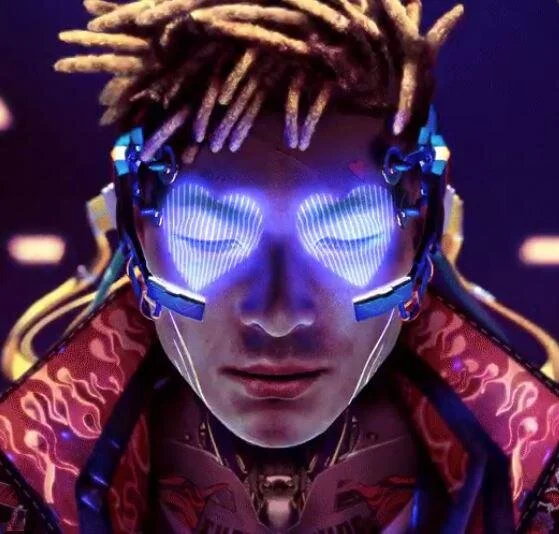
Braindances can be viewed with wired or wireless headsets known as “Wreaths”
The second is in bars which have a couple “Black Boxes” to view braindances in, and a subscription to a service that distributes braindance recordings.
The 3rd way is to buy your own Black Box and rent chips from arcades or subscribe to BD services yourself.
The History of Braindance
Braindance, otherwise known as the “Alternative Reality Process”, was invented by Yuriko Sujimoto a graduate of the University of California at Santa Cruz in 2007. Using the Moss equation, which is the basis for neural responses, and a Netrunner interface, Sujimoto managed to record all of her thoughts, emotions, and physical sensations into a standard information chip. Plugging the chip back into the Netrunner interface or Cybermodem, she was able to experience all the thoughts, emotions and physical sensations that she had recorded.
Knowing this, and trying to apply it to real-world problems, Sujimoto deduced that it was best used as a method to reform and recondition hardened criminals and their mental states. At the time many believed that once you committed such crimes, you gave up your rights and were reduced to a human guinea pig. Criminal reconditioning was approved by the Supreme Court during this time period for certain anti-social crimes.

A sexual braindance ad in 2077
Before this, criminal reconditioning was largely ineffective, but with Sujimoto’s new discovery, this psychological reconditioning could be done cheaply, effectively and relieved a lot of the stress that prisons felt with overcrowding. To create an aversion to crimes in the minds of these criminals, these braindances had to be recorded in such a way where if a criminal repeatedly played it, they would start to loathe all crime in general and lull themselves back into a mentality that is safe for the streets.
Conditioning Criminals With Braindance
In order to do this, however, they had to make new recordings of criminals actually committing these crimes and recording their sensory and neural processes. This was a daunting task for Sujimoto and Norman Lassimer who had joined Sujimoto as a psychologist to monitor their progress. Sujimoto eventually got the Californian State Senate to fund the project and offered reduced sentences to volunteers who would re-enact these crimes, with small changes made to them, that when viewed would turn any potential criminal off that specific crime. This got the attention of Militech who stepped in and helped with funding in exchange for a license to market braindance machines as a military simulator.
Despite this, the program still lacked volunteers, but on March 7th, 2009 Sujimoto and crew would get a big break. On this date, Harold MacLeroy a convicted mass murdered was due to be executed by the state. Before he was though, he made one final and unusual request. If Militech would compensate his family with a sum of money, MacLeroy would allow himself to be killed while recreating one of the scripted crimes. MacLeroy allowed his death to be recorded and this was a pivotal turning point. 8 More volunteers made similar deals within the year with Militech, and their deaths were recorded as well.
Braindance Trials
This initial pool of BDs were taken to trial at San Quentin Correctional Facility, where the first inmate Gerald Weisenheimer spent nine hours a day for one week, living exclusively in these introductory braindances. This initial trial was successful as Weisenhemer, who was a convicted robber swore to never rob anyone else again, and mentioned he would Never touch another person’s money as long as he lives” This first success led the State of California to further fund the program, and with increased funding in 2009, and a governmental contract to produce more machines and tapes, Lassimer and Sujimoto formed Braindance Inc. This also led braindance to be pivotal in treating and reforming different kinds of criminals, namely Cyberpsychos who suffer from Cyberpsychosis, a prevalent mental disease in Night City you can induce if augment yourself with too much cyberware.
Creating A Braindance
Creating a braindance for mass consumption is a fairly straight forward process. All you need is one braindancer, a video technician, and a braindance technician who controls the neural feeds. A solo may also be required to get the braindancer out of a dicey situation.
Recording a braindance can be done in one of two ways, either via a scripted sequence or by real-life events. The more scripted ones tend to be more rigid and don’t stimulate the same emotions within the braindancer as real-life events, and the quality of the recordings tends to suffer because of it. Unscripted ones are compiled with the braindancer on the fly and are more free-flowing. They have an authenticity to them that the viewer can really appreciate.
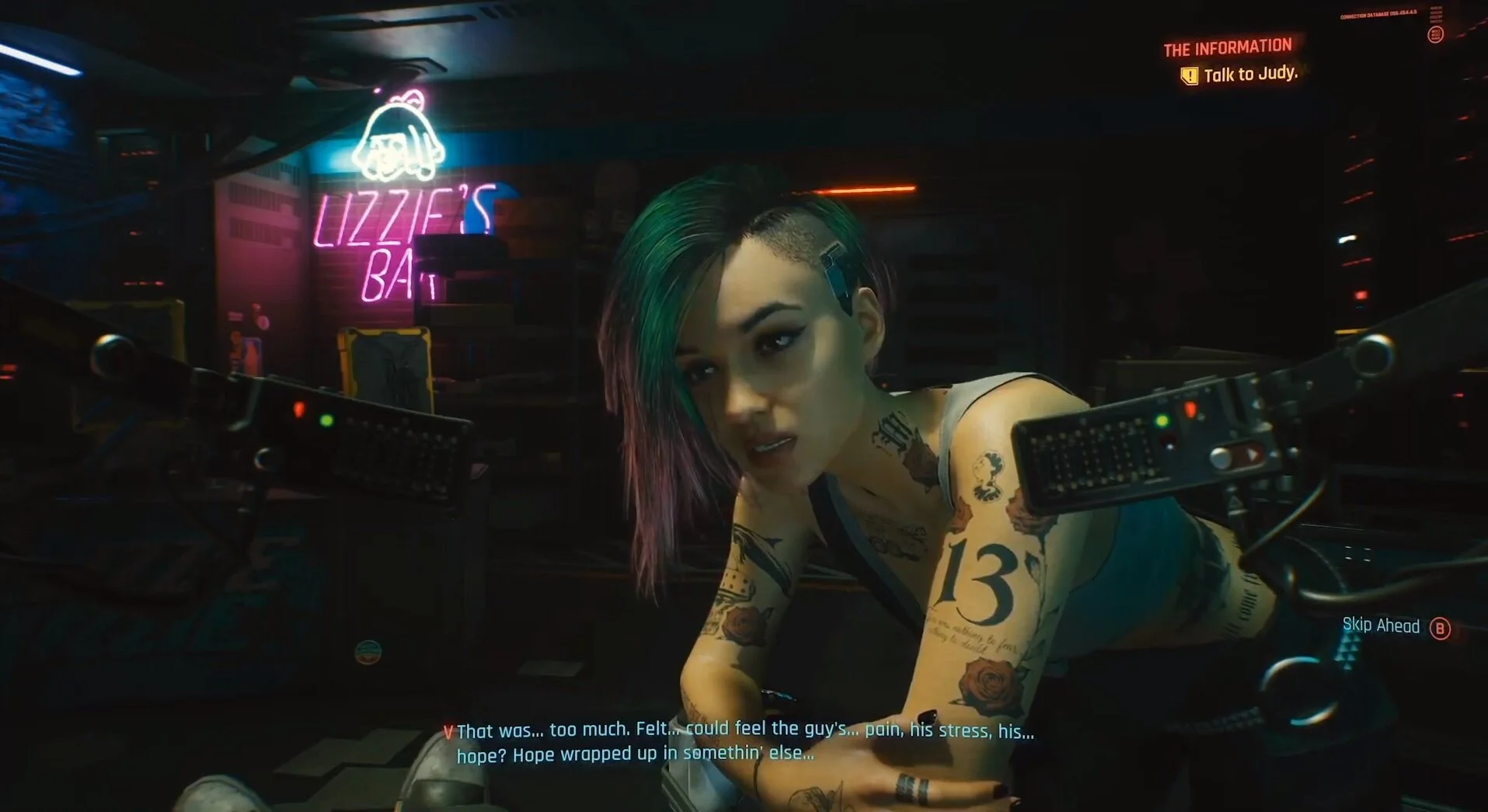
Cyberpunk 2077’s Judy Alvarez, a Mox Braindance technician monitors V post braindance
A braindancer typically compiles 5 hours of footage and hands it off to an editor who curates the footage down to around and hour. Editing consists of the editor going through the braindance with the sensory elements turned off, in an attempt to tailor each specific interaction and experience. Say in a braindance you got shot? The editor could theoretically go through and make that precise moment where you got shot, feel like a tickle, or a warming sensation, and is up to the creativity of the editor.
Once edited, it is submitted for approval to the braindancer and a corporate marketing team. After it has been approved the braindance chip is distributed for testing where it is viewed and commented upon. If the chip is well received, it enters a stage of mass production and starts entering stores.
Braindancing Dangers
There are some dangers associated with braindance, however. Illegal duplication and distribution of braindance chips come with a multitude of risks. Homemade braindance chips do not undergo the same scrutiny and safety standards as mass-marketed ones, and illegally produced recordings sometimes contain the death of the Braindancer. The bodily shock of dying in recorded form can many times shock the viewer and can stop their heart. Another risk involved in braindance is subliminal suggestion. When braindance first became available to the public, rumors were that people’s personalities were being altered and even overwritten by more intense braindances. It was soon after revealed that some Black market braindance chips, had liche programs strong enough to overwrite a person’s personality completely, and wipe their sense of self. braindances by nature are also very addictive and can lead to people letting their lives rot away, whilst they get caught up in the glitz, glam, and action of these heavily induced sensory experiences.