
What Is Cyberpunk?
You already live in a cyberpunk world.
Your phone tracks everything you do. Your boss monitors when you're "active." Your computer serves you ads for products you were just thinking about. & in 2026 that’s just the tip of the ice-berg.
But before Facebook’s began constructing the Metaverse, Neal Stephenson coined the term in Snow Crash.
Before we began spending more time with our faces pressed to screens, William Gibson imagined Cyberspace, a consensual digital world operating 24/7.
Before the Walled City of Kowloon was rubble, Metropolis and Dredd showed the reality of a hyper-compressed city.
The loop of life imitating art and vice-versa has never felt more obvious than with the Cyberpunk genre. But what actually is the Cyberpunk genre and where did it come from?
What Is Cyberpunk?
Cyberpunk is a subgenre or more accurately, a mode of science fiction. It leans to the softer side of sci-fi vs hard sci fi. While it can be focused on scientific accuracy, and many times is, these stories revolve around the societal implications and conditions that are brought about due to technology, rather than an emphasis on the technology itself.

Left: mirrorshades, middle: transmetropolitan, right: snatcher.
It features countercultural antiheroes trapped in dehumanized, high-tech dystopias. These are worlds where globalization has empowered rapid, unsustainable growth leading to mega-cities that house the world’s population. As society has evolved, so has our need to transcend the limitations of ourselves. In this pursuit to be more efficient, competitive, and valuable to society, the fusion of flesh and machine is the new normal.
Summed up best, Cyberpunk is High-Tech & Low-Life. Technology has never been more accessible and widespread. But social decay has never been higher.
Cyber & Punk: The Etymology
Cyber:
“Cyber” comes from Norbert Wiener's Cybernetics (1948) which was the first book of its kind to dissect the study of feedback loops between systems. These feedback loops have applications in everything from computing to psychology.
In the context of Cyberpunk this means the feedback loops between man and machine, flesh and metal. Self-regulating systems blur the boundary between human and artificial.
The Greek root: kybernētēs, the "steersman." Moving a ship's rudder creates a feedback loop. Adjust the angle of the rudder and you create a loop that adjusts the direction of movement.
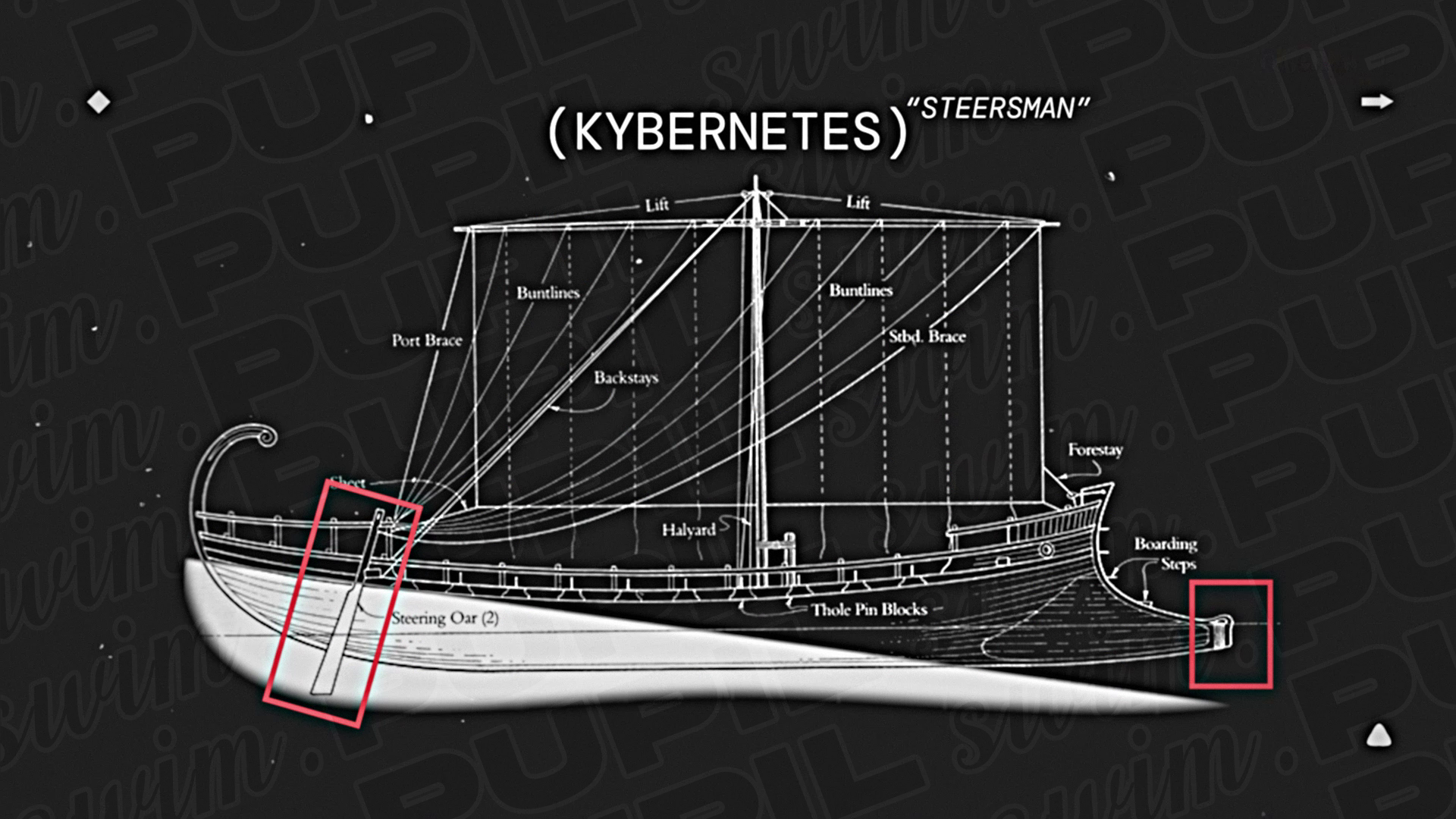
angling the rudder or oar of a ship creates a “feedback loop” that leads to directional change.
It is ironic in that one of the most powerful thought experiments, “The Ship of Theseus”, meshes perfectly with the concept of cybernetics. It asks at what point in removing and replacing of components of a ship, can it be classified as a new ship? Can it at all? At what point of augmenting the human body are you no longer yourself? Do you draw the line at a pacemaker or a full body conversion?
This thread is woven through the best of Cyberpunk, Tyrell’s “more human than human” motto, David Martinez’s image of invincibility as he loses his humanity through cyberware, Lawnmower Man’s transformation from mentally handicapped to all-knowing diety.
PUNK:
You might think punk is all about mosh pits and mohawks, leather jackets and studded belts, but punk goes beyond the counter-cultural look. Punk is a mentality; counter-authoritarian, anti-establishment, & a refusal to bend to conformity. the punk movement aims to dismantle the system that says "comply” without reasonable justification.
It’s a “DIY-attitude” for everything, and using technology as an equalizer. with this cyborgization of their bodies they aim to puncture through an established order that no longer serves the people, whether its on the streets of the megacities or the matrix of cyberspace.

Artwork of Case & Molly Millions from William Gibson's Neuromancer by Japanese illustrator Suemi Jun.
“The street finds its own uses for things.” - burning chrome
“Punk” is the most important character archetype in not only these stories, but as we find ourselves in similar circumstances in our realities. Punk is the forgotten side of modern cyberpunk and post-cyberpunk media.
Without punk, you likely just have dystopian sci-fi with cool gadgets. With it, you have critique, satire, and edge. You have gonzo journalism, psychotic rebels, and amphetamine addicted-hackers. & they are all very, very pissed off.
A Brief History of the Genre
A relatively unknown author by the name of Bruce Bethke first invented the term in early 1980. Using it for his short story Cyberpunk!, published in November 1983 in Amazing Stories he wanted "a snappy, one-word title that editors could remember," but also wanted to fuse the juxtaposition of teenage angst with hacker culture.
While in isolation, Cyberpunk! likely would have never had the momentum to become more mainstream, editor and author Gardner Dozois used it in an article written a year later. Titled "Science Fiction in the Eighties", he described William Gibson and other writers in the '80s "Cyberpunk Movement," writers who had given their stories the same counter-cultural hacking-centric protagonists and ideas in their own bohemian sci-fi works.

Gardner dozois’ article “science fiction in the eighties”.
Had Dozois not labeled them "Cyberpunks," we might be calling this genre something entirely different. Some briefly floated "Neuromantics" as an alternative, a play on Neuromancer, but it never gained traction. Cyberpunk was simply more marketable.
Rocket fuel for the operating system, the rules of the genre? That’s Neuromancer written by William Gibson, the quintessential cyberpunk novel published in 1984, a mind-bending blend of noir grit, substance-abusing hackers, street samurai, and corporate interests.

Rocket fuel for the UX of the genre, the look of the genre? That’s Bladerunner, released in 1982, the quintessential hard-boiled cyber-noir adapted from Philip K Dick’s Do Androids Dream of Electric Sheep.
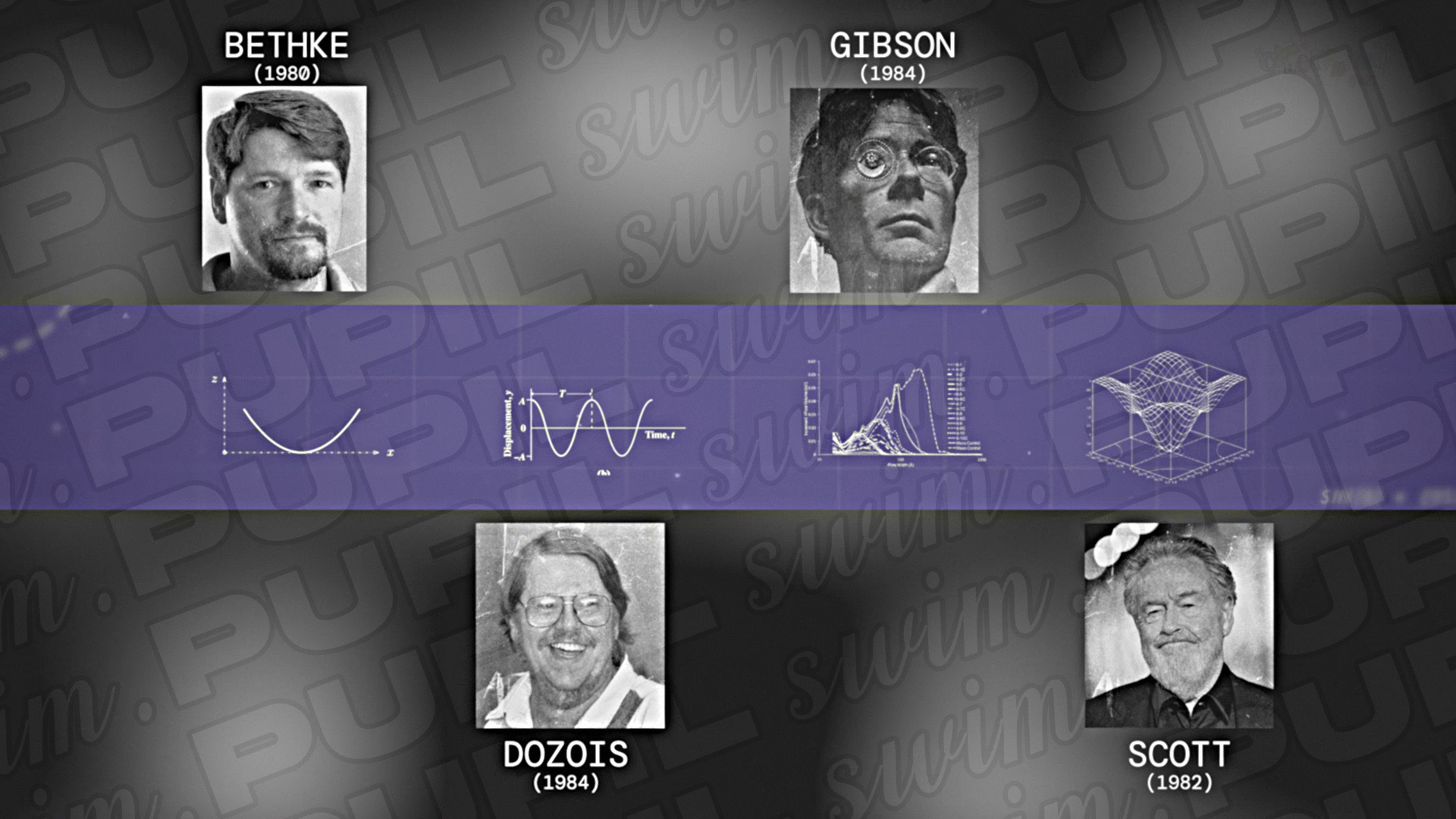
Bruce invented the word. Gibson built the world. Ridley Scott formed the visual language. All on the shoulders of the influences, works and movements prior.
THE 8 “INGREDIENTS” OF THE CYBERPUNK GENRE
Genre labels are fluid and while debating about defining what’s classified as Cyberpunk vs Cyber-Noir vs Tech-Noir vs Cyber-fantasy is, in my opinion, an exercise in futility, I’ve created a system of 8 ingredients that Cyberpunk genre works pull from.
The more ingredients within each formula, the more “core” cyberpunk something can be considered.
Make sense?
For the purposes of this blog, i’ll be concise, but if this part interest you, I recommend watching the video embedded at the top of this post as it goes more in-depth.
If you want to download this template, you can sign up to the newsletter below and I’ll send it to you for free so you can start using it as you expose yourself to dystopian media.

INGREDIENT 1: CORPORATE RULE
In cyberpunk, corporations don’t just sell you products. they function as governments, militaries, and infrastructure all rolled into one.
They’re the ones writing and re-writing the rules, enforcing them with private armies and lucrative contracts.

They own the flow of information, they control the media, and quietly pull the strings. Many in the 80s cyberpunk movement saw how people were more aligned with brands then they were nationalistically patriotic. Combine this with the internet being seized by the corporations and you have a reality formed by the corporations and taken as face value by the suppressed populace.
Cyberpunk asks: What happens when profit has more power than policy? When unelected boards have more real-world control than any president or parliament, every part of your life is downstream of corporate incentive. & that water is usually tainted.
Fictional Examples:
Tyrell Corporation (Blade Runner):
Builds artificial life, plays god, and answers to nobody.Tessier-Ashpool (Neuromancer):
An orbital family empire with god-tier AI and total insulation from consequences.Arasaka (Cyberpunk 2077):
A megacorp with its own army, black ops, and political puppets.
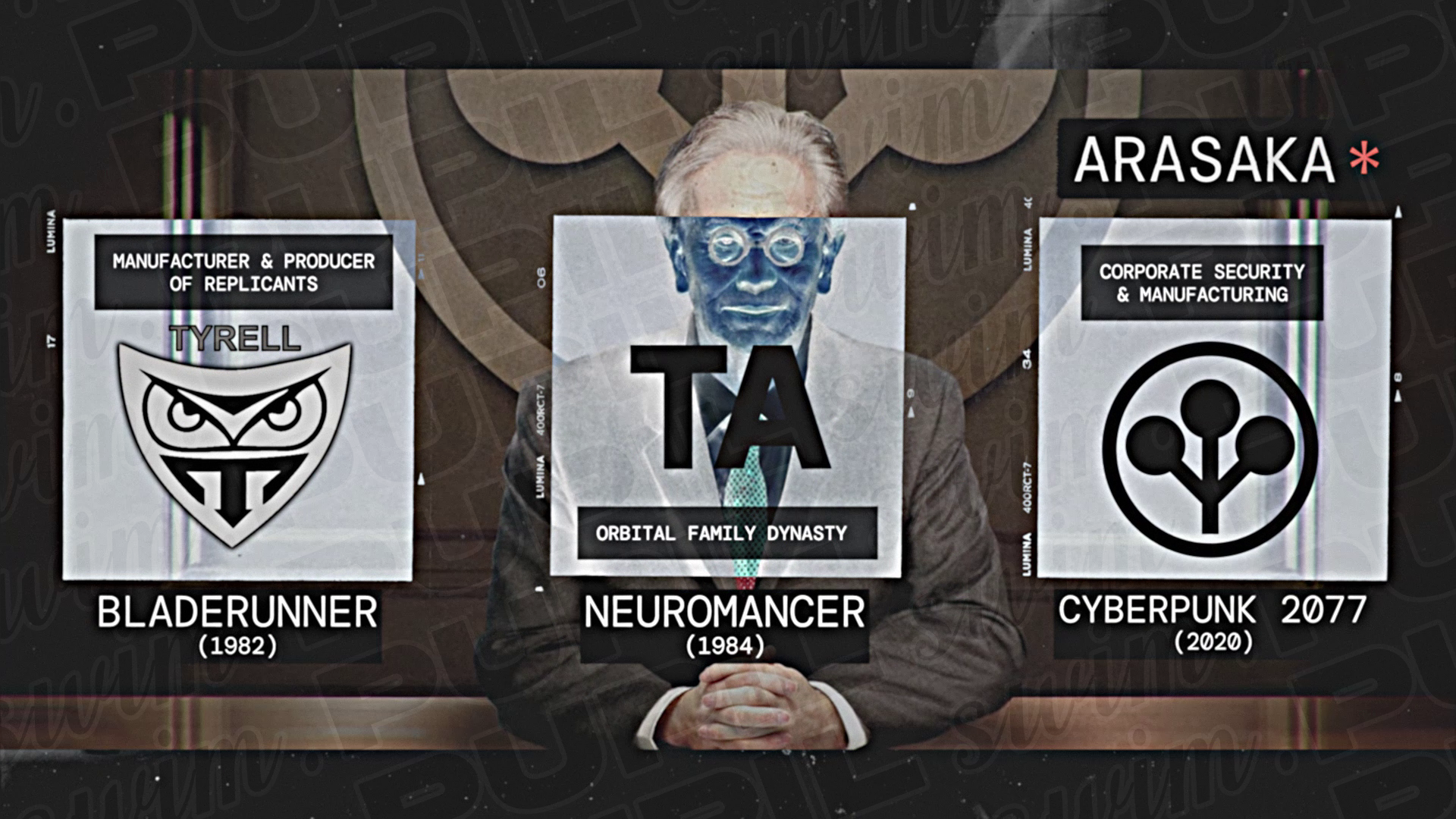
dominant megacorps across cyberpunk media include: tyrell, tessier-ashpool, and arasaka.
Real-World Examples:
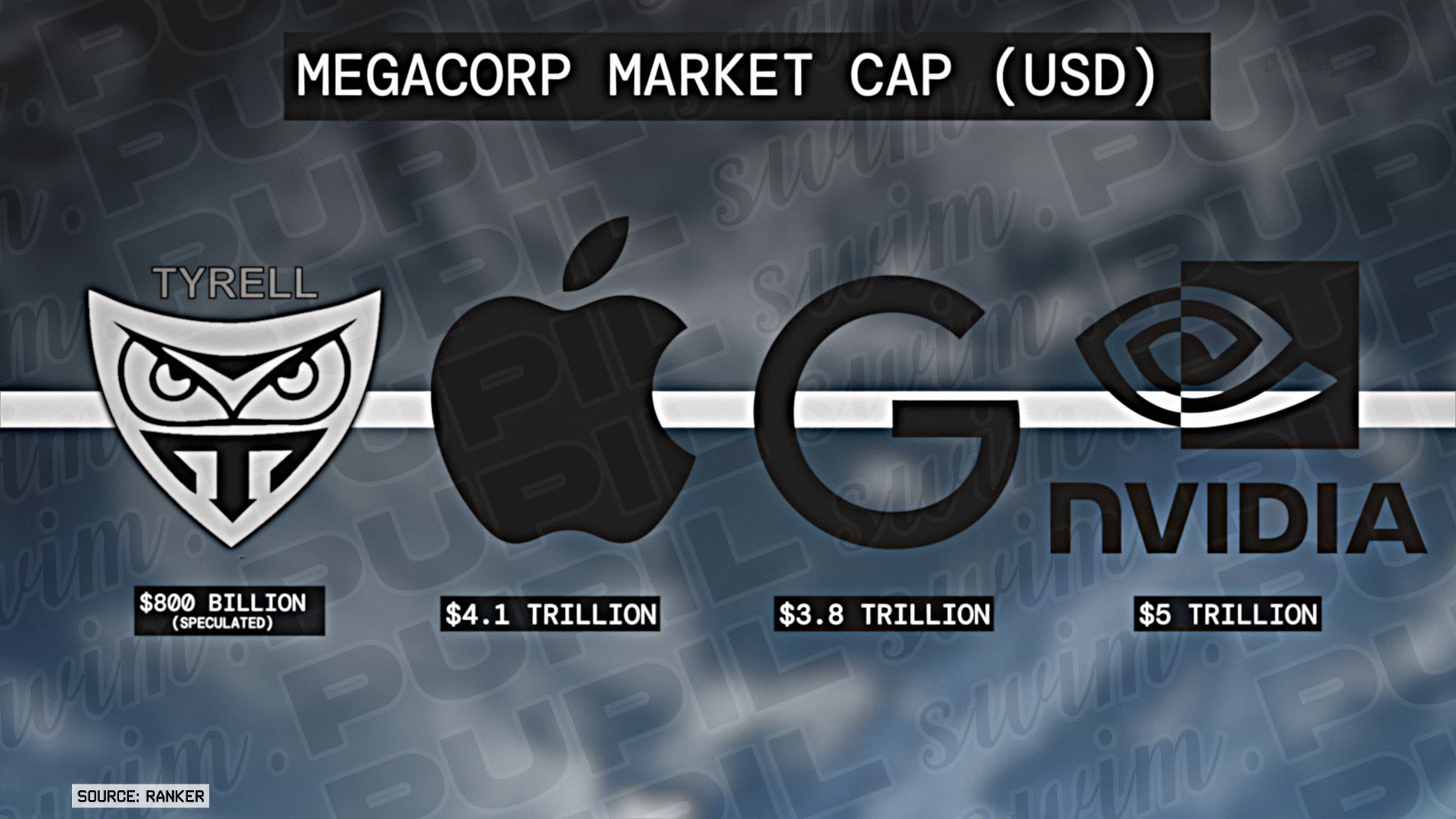
Apple, Google, Meta, Amazon, Tencent, NVIDIA. Companies with GDP-sized valuations, private data empires, and more direct influence on your daily reality than your local government.
INGREDIENT 2: TECH-DRIVEN INEQUALITY
Advanced technology doesn’t flatten class divides, contrary to its initial intent. The wealthy use tech to extend health, lifespan, and control. The poor get predatory, unstable, black-market upgrades that can be repossessed, fry their neurons, silently control them, or end up as ticking time bombs.
We like to tell ourselves “technology is an equalizer.” that once we have the ability to do X, Y and Z with advanced tech humanity will reach some magical frontier of quality of life for all. & for the longest time our science-fiction reflected just that.
Cyberpunk flips that: what if tech is just a more efficient way to lock people into the bottom rung?
Fictional Examples:
Cyberpsychosis (Cyberpunk 2077 / Edgerunners):
Try to chrome your way out of poverty and the chrome eats you alive.Replicants (Blade Runner):
Engineered slave-class with built-in expiry dates.Corporate-grade vs street-grade augmentations:
Corpo execs get stable, premium mods. Street rats get overheated junk bolted into their skulls.
Real-World Examples:
Private healthcare vs public; luxury longevity biotech vs basic medication scarcity; “move fast and break things” tech culture where the things being broken are usually poor communities.
INGREDIENT 3: SURVEILLANCE & DATA ECONOMICS
Everything is watched, logged, and monetized. Your movements, biometrics, relationships are commodified. Privacy is a greyed-out opt in box. You no longer have the right.

In cyberpunk, your value to the system isn’t your humanity, potential, or genius. it’s your long-term value, your life-time spend and your ROI. You are a consumer. Beyond that, your identity is irrelevant.
Fictional Examples:
Construct ROMs (Neuromancer):
Dead hackers recycled into software tools with limited agency. Corporations deny you death to use you as software tools.Netwatch / Turing Police (2077 / Neuromancer):
Institutions that police the flow of information and AI, deciding what intelligence is allowed to exist.Data Economies:
Information is leverage, and creates a whole economy legit and illicit. Data is power and profit.
Real-World Examples:
Adtech, social media tracking, facial recognition, location data brokers, genetic testing data.
INGREDIENT 4: IDENTITY & TRANSHUMANISM
In many genre works bodies become modular, memories become editable, personalities become files. Who are you in a world where these are interchangeable? What seperates you from your peers? Does it matter?
Fictional Examples:
The Puppet Master (Ghost In The Shell):
An intelligence born from data claiming personhood, forcing a legal and philosophical crisis.Deckard (Blade Runner):
Is he human? A replicant? Does it matter if his experience feels real? Why do the replicants have more empathy than the humans in this future?Do Androids Dream of Electric Sheep?:
Empathy boxes, fake animals (simulcra & simulation), artificial intimacy. Authentic emotion becomes locked away, only accessible through purchase.
Real-World Examples:
Neurotech, brain-computer interfaces, deepfake identities, AI voice clones. Here’s a question for you. Who knows you better, your family - or Google?
INGREDIENT 5: CYBERSPACE AS REALITY
Networks, simulations, and virtual spaces aren’t just tools, they’re parallel realities where power is exercised and lives are destroyed, and even built. Cyberspace isn’t a side feature; it’s the primary battlefield. It is the last contested space between the corporations and the streets.
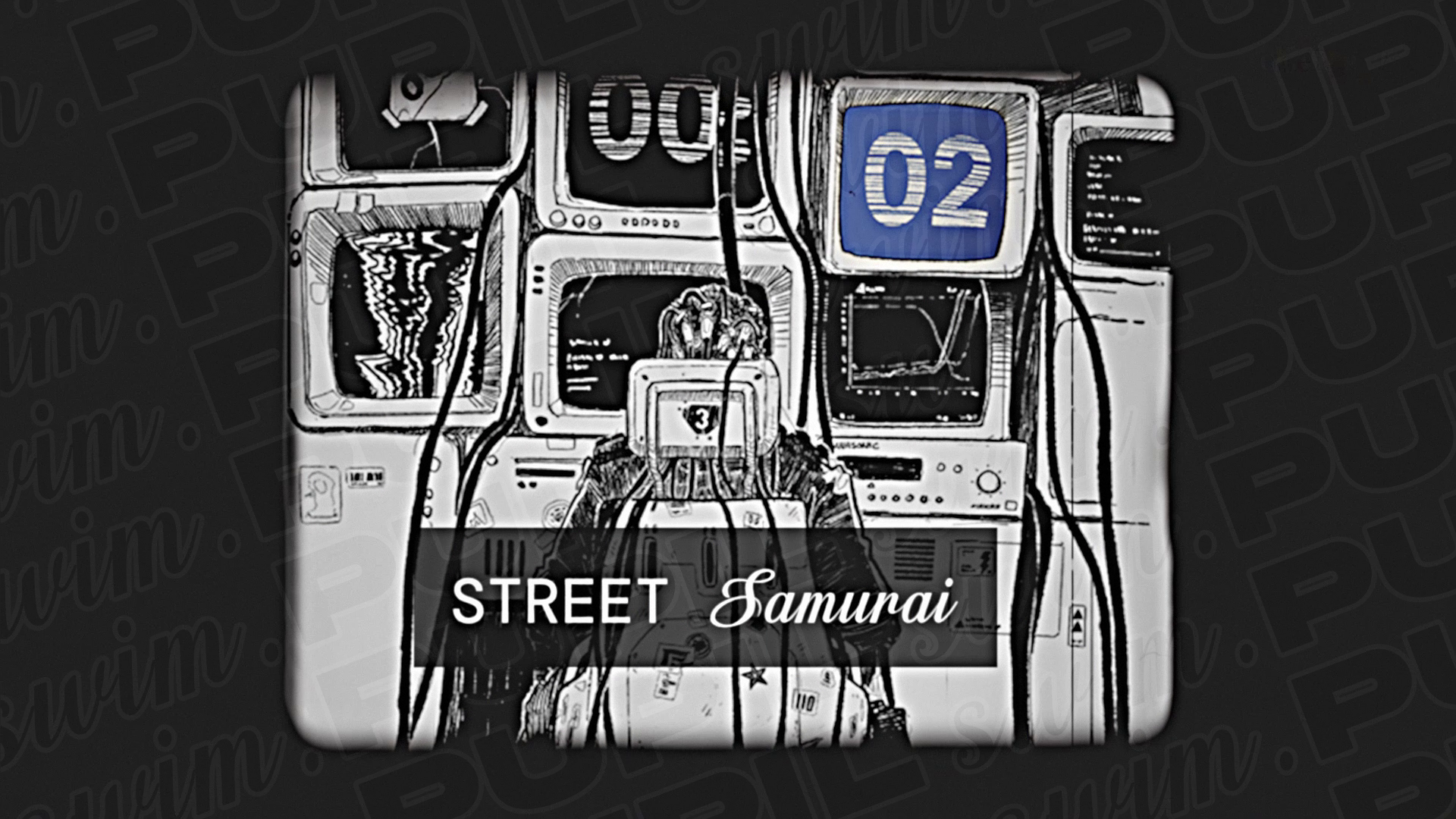
It also has spiritual connotations that pair with identity and transhumanism.
Cyberpunk treats the digital layer as more consequential than physical streets. In many ways Cyberspace is the only place where you have a sliver of agency.
Fictional Examples:
Cyberspace (Neuromancer):
“A consensual hallucination experienced daily by billions.” Console cowboys jacking into pure data.The Matrix (The Matrix):
Entire human civilization pacified in simulation while their bodies are farmed.The Old Net & Blackwall (Cyberpunk 2077):
A quarantined digital wildland full of rogue AIs, held back by a fragile firewall.SimStim feeds (Gibson):
People consume other people’s sensory experiences as a primary form of entertainment, using parallel technology as Cyberspace decks.
Real-World Examples:
Always-online life, algorithm-filtered reality, social media as a primary identity layer, data centers as the latest resource hogs, and the fact that a server outage can cripple nations faster than a bomb.
You already have your nose in your phone all day. You are constantly jacked in. You might as well have a cyber-limb. But do you control the feedback system or does the feedback system control you?
INGREDIENT 6: MEGACITIES & ECOLOGICAL COLLAPSE
The natural world is either dead, dying, or inaccessible. Humanity retreats into massive, vertical, hyper-dense cities where nature is a luxury product or a simulation. The city itself is the antagonist. It’s brutalist skyscrapers might as well be prison bars. Or at the very least, a reminder to not rock the boat of the established authority or order.
This ingredient introduces THE VERTICAL class system. Poverty on the ground. Wealth in penthouses. Ultra-elite off-world.
Fictional Examples:
Peach Trees (Dredd):
An entire micro-society stacked in one mega-block, ruled by gangs.Neo-Tokyo (Akira):
Rebuilt over ruins, the cycle of life and death, and the decaying streets vs the ivory towers of the military and corps.Do Androids Dream:
Real animals are so rare they’re status symbols; synthetic pets fill the gap.
Real-World Examples:
Mega-cities like São Paulo, Lagos, Mumbai, Hong Kong.
INGREDIENT 7: PUNK RESISTANCE & NOIR DNA
The street fights back, poorly, inconsistently, and often self-destructively. Punk resistance is the refusal to quietly accept systems designed to crush you, even if you can’t win. Noir is the mood: fatalistic, morally grey, and deeply human.
This is where cyberpunk gets its soul. Punk gives it teeth; noir gives it tragedy.
Fictional Examples:
Kaneda’s gang (Akira):
Bosozoku bikers raging against a decaying city and a useless adult class.Elliot Alderson (Mr. Robot):
Too anxious to riot in the streets, but wages war from a terminal.Replicants (Bladerunner):
In BR the punk themes manifest in the replicants and their desire to break free from enslavement. Their ideology is the mind virus for Deckard and aligned Bladerunners, who at first is anything but punk.Molly Millions (Neuromancer):
A razor-girl mercenary playing corpo games while refusing to be owned.
Noir angle:
Like classic noir detectives, cyberpunk protagonists uncover conspiracies they can’t really stop. The victory is surviving.
Real-world parallel:
Hacktivism, whistleblowers, decentralized movements, DIY culture, street protests, any sort of rebellion. Cyberspace is the playground of the punk. Exposure to the streets and the skyscrapers both is what gives the noir detective the perspective.
Punk is the forgotten element of Cyberpunk. A hollow dystopia with nothing to say can have all the bells and aesthetic whistles of Cyberpunk, and still miss the core essence of the genre.
INGREDIENT 8: ESCAPISM & SUBSTANCE USE
In cyberpunk worlds, drugs, both chemical and technological, are everywhere.
They're escapism for those trapped at the bottom, performance enhancers for those clawing their way up, and pacification tools for corporate control.
Chemical Substances In Fiction:
Case's addiction (Neuromancer): Amphetamines, cocaine, "wizard" drugs. He's a junkie before he's a hacker.
A Scanner Darkly: Philip K. Dick's exploration of addiction destroying identity.
Akira: Pills that are “bad for health, good for education.”
Technological Escapism In Fiction:
Braindance (Cyberpunk 2077): Recorded experiences sold like drugs. People addicted to living other people's lives. Combatting the “Cathedral Effect” synonymous with a compressed dystopia.
SimStim (Neuromancer): Molly's recorded senses sold to consumers. Your experiences are commodified. This includes sex.
The Matrix: Humans pacified in simulation while machines harvest their bodies and use them as living batteries.

Performance Drugs:
Smart drugs: Cognitive enhancements to compete (Amphetamines, skill-chips, etc)
Combat stims: Military-grade chemicals and implants like 2077’s “Sandevistan”.
Corporate Control:
Soma (Brave New World): Proto-cyberpunk chemical pacification from George Orwell.
Substances keeping people docile, distracted, or desperate.
Real-World Examples:
Opioid epidemic, nootropics, combat drugs and sensory suppressants, ADHD meds as performance enhancers, reality tv, news and media, social media as the new “SOMA”.
WHERE TO START
So the stage is set for you to dive deep into this sci-fi subgenre.
Here are my recommendations for getting a crash course on Cyberpunk. This is merely a starting point!
cyberpunk Books:
Neuromancer (Gibson) – The blueprint. A must read to understand the structure of the genre.
Do Androids Dream? (Dick) – Used as a loose interpretation for Bladerunner. Some aspects are omitted from Bladerunner, including “Mercerism” and the Empathy Boxes. Philip K Dick, although not classified as a “Cyberpunk” author, has as much influence on the genre itself as Gibson, Ridley, and Moebius do.
Snow Crash (Stephenson) – Satirical, and a “love it or hate it” entry into the Cyberpunk genre.
cyberpunk Films:
Blade Runner (1982) – The aesthetic. Even William Gibson has said that this was his vision for Neuromancer when he first saw the film. He actually panicked, because at the time he was 2/3rds done Neuromancer, and he believed people would think he had knocked the film off, causing him to re-write significant segments.
Blade Runner 2049 (2017) – Moody, meloncholy, and cinematic. I adore this film for the questions it poses, its atmosphere, and its slow burn. If you like this, you’ll like films with similar flavors without the sci-fi layer like Drive and Nightcrawler.
The Matrix (1999) – Mainstream entry, and my personal favorite for the “Punk” side of things. Later entries are poor, but The Animatrix is a spin-off that deserves more views.
Dredd (2012) – Brutal, vertical city. One of my favorite interpretations and a good example of the dark humor that the genre portrays. It’s depiction of Megabuildings has been incredibly influential to more modern Cyberpunk works like Cyberpunk 2077.
cyberpunk Anime & manga:
Ghost in the Shell (1995) – Heady and philosophical. If you gravitate towards the “Ship of Theseus” and the idea of consciousness, Ghost In The Shell is for you. While later entires focus on the political structure and law and order in a high-tech future, Oshii’s 95 anime is more introspective.
Akira (1988) – Punk rebellion, body horror. This is still the gold-standard of hand crafted animation. It’s cultural resonance is probably the most widespread of all the above, besides perhaps The Matrix.
Edgerunners (2022) – Perfect cyberpunk tragedy. A modern masterpiece from studio Trigger and CD PROJEKT RED, who have both proven the understand the genre.
cyberpunk Games:
Cyberpunk 2020 & 2077 – Mike Pondsmith and CD PROJEKT RED make a collaboration made in heaven. 2077 is love-letter to 2020 and the genre. For the most expansive world-building of any of the entries, the RTalsorian sourcebooks are a must.
Deus Ex – Augmentation ethics, and borderline cringey-punk one-liners. It teeters between corny and capable, and it’s for that reason it is adored by many.
So now that you have the gist, let’s explore how life imitates art with the “Cyberpunk City”, and the ”control stack”: [LINK SOON!]